

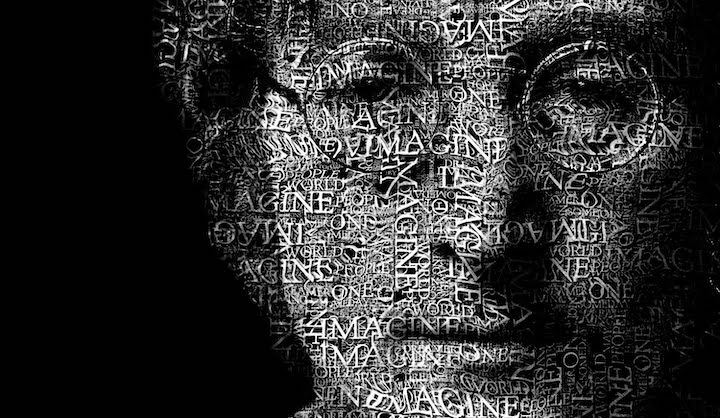
For more than two decades now, I have been both teaching and writing poetry. However, there is one type of poetry that never fails to amaze my students with its strength: visual or concrete poetry, in which the layout of words on paper becomes an element of meaning as well. The vast majority of readers become familiar with visual poetry at some point in their education, but they then promptly forget about it, regarding it as a mere gimmick. However, there is something very profound about the nature of visual poetry…
Meaning is more than words
Visual poetry operates under the premise that not only does meaning lie in words, but meaning lies in the positioning of words, the form that those words take. If a poem about falling takes the shape of a fall and a poem about expansion occupies a space on the page, the form adds to the depth of the content in ways that words themselves do not allow. This demonstrates the complexity of communication, how presentation is just as important as content in itself.
The perception of language seems to be based on its being entirely vocal; yet, visual poetry challenges such perception by demonstrating that the visual element is inseparable from the verbal one and may be consciously employed. In fact, there is no neutral placement of letters and words on the paper surface – they are always perceived by the reader and evoke certain emotions. Thus, visual poetry simply draws attention to the visual nature of written text and makes us more sensitive to the impact of presentation on perception.
The constraint that frees
Writing a visual poem presents an intriguing restriction; that of ensuring that the words fit not only as text but also as visual shapes, meeting both requirements at once. Such restrictions do not stifle creativity; on the contrary, they often unleash it because the poet will find himself in need of finding words that can satisfy both requirements. It is this aspect of the requirement that often leads to innovative results that would otherwise never be discovered through conventional poetry writing.
Devices which assist in the arrangement of words in shape allow for this format to become available, and allow individuals to play around with their poetic expression visually. A free concrete poem generator lets someone experiment with words as shapes easily, and the real creativity remains in choosing the words and the form that together make meaning, which is exactly where the poet’s work belongs.
Play and experimentation
At its very core, visual poetry is all about experimentation and playfulness, encouraging people to play around with words and visuals, to try out different combinations. Such experiments are the best way to develop one’s skills and come up with great ideas, especially since visual poetry helps one get more involved with the process. It can engage those people who do not consider themselves poets and encourage them to experiment by simply having fun with the poetic forms.
This is how I employ visual poetry in class to get my students more relaxed, regardless of whether they write poetry or prose. In the fun process of playing with the shape of the words, the students build a sense of playfulness in their approach to words, which then influences the rest of their work. Visual poetry becomes an entry point into creativity and writing that doesn’t take itself seriously, but instead allows experimentation. Play, in other words, turns out to be one of the best ways into creativity.
Seeing language differently
One of the greatest gifts from exploring visual poetry is that once you experience the power of language through its shape, there is no going back, as you will never look at any other text without seeing it visually. This will enhance your appreciation for language and allow you to appreciate more fully the ways in which meaning can be expressed through visual elements. It is not just about being clever, but about gaining a deeper appreciation of how meaning works.
Rediscovering the form
Should you have dismissed visual poetry as a pastime of childhood, it is time to revisit it for its own enjoyment and its capacity to hone your sense of meaning. Even a quick experiment with FaddyAI.com arranging words into shapes can reawaken a sensitivity to the visual dimension of language that enriches everything you write and read.
The poetry of vision, where words turn into form and structure takes on significance, draws upon the profound knowledge that language itself is multi-dimensional, that form influences meaning just as much as content. The restrictions of visual poetry inspire, the play of the form allows you to be open to experiment, and working with it forever makes you more aware of the visual aspects of language. It is certainly not a stunt, but a gateway to a deeper appreciation of language, and re-experiencing its power is a subtle joy.
But what I adore most about visual poetry is that it gently opens the door which was closed by many in childhood – the door to language which can become a subject of play, not only a tool for everyday communication. As soon as someone starts arranging words according to a certain pattern and realizes that this form adds some extra dimensions to the sense of the poem, he realizes that language becomes flexible, expressive and much more interesting than it seems at first glance. Of course, this revelation will affect everything the writer does in future. The form which may seem childish proves to become a real door to another dimension of language, and crossing it is a real joy for creativity.
